PALM-TREEs Brief: From Policy Commitment to Last-Mile Action: Strengthening Inclusive Climate Governance in Lagos
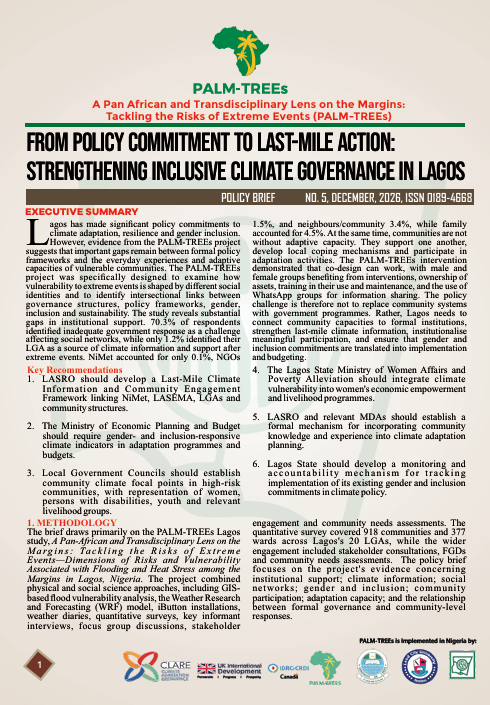
Lagos has made significant policy commitments to climate adaptation, resilience and gender inclusion. However, evidence from the PALM-TREEs project suggests that important gaps remain between formal policy frameworks and the everyday experiences and adaptive capacities of vulnerable communities. The PALM-TREEs project was specifically designed to examine how vulnerability to extreme events is shaped by different social identities and to identify intersectional links between governance structures, policy frameworks, gender, inclusion and sustainability. The study reveals substantial gaps in institutional support. 70.3% of respondents identified inadequate government response as a challenge affecting social networks, while only 1.2% identified their LGA as a source of climate information and support after extreme events. NiMet accounted for only 0.1%, NGOs 1.5%, and neighbours/community 3.4%, while family accounted for 4.5%. At the same time, communities are not without adaptive capacity. They support one another, develop local coping mechanisms and participate in adaptation activities. The PALM-TREEs intervention demonstrated that co-design can work, with male and female groups benefiting from interventions, ownership of assets, training in their use and maintenance, and the use of WhatsApp groups for information sharing. The policy challenge is therefore not to replace community systems with government programmes. Rather, Lagos needs to connect community capacities to formal institutions, strengthen last-mile climate information, institutionalise meaningful participation, and ensure that gender and inclusion commitments are translated into implementation and budgeting.