PALM-TREEs Brief: From Climate Vulnerability to Resilient Communities: Scaling Locally-Led Adaptation in Lagos
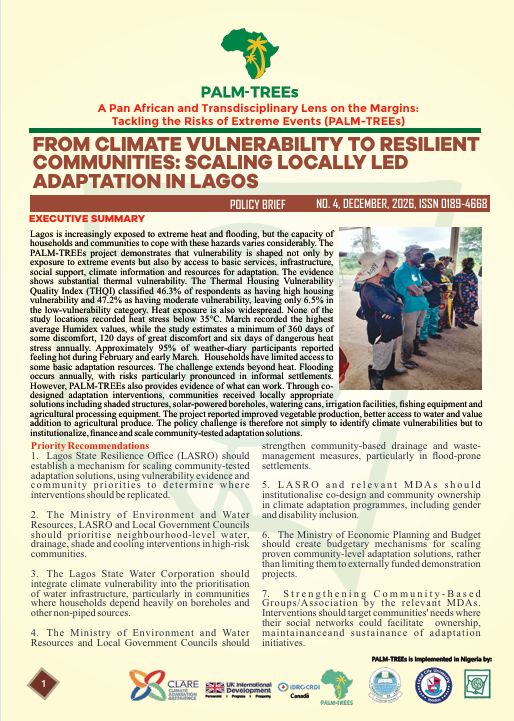
Lagos is increasingly exposed to extreme heat and flooding, but the capacity of households and communities to cope with these hazards varies considerably.
The PALM-TREEs project demonstrates that vulnerability is shaped not only by exposure to extreme events but also by access to basic services, infrastructure, social support, climate information and resources for adaptation. The evidence shows substantial thermal vulnerability. The Thermal Housing Vulnerability Quality Index (THQI) classified 46.3% of respondents as having high housing vulnerability and 47.2% as having moderate vulnerability, leaving only 6.5% in the low-vulnerability category. Heat exposure is also widespread. None of the study locations recorded heat stress below 35°C. March recorded the highest average Humidex values, while the study estimates a minimum of 360 days of some discomfort, 120 days of great discomfort and six days of dangerous heat stress annually. Approximately 95% of weather-diary participants reported feeling hot during February and early March. Households have limited access to some basic adaptation resources. The challenge extends beyond heat. Flooding occurs annually, with risks particularly pronounced in informal settlements.
However, PALM-TREEs also provides evidence of what can work. Through co-designed adaptation interventions, communities received locally appropriate solutions including shaded structures, solar-powered boreholes, watering cans, irrigation facilities, fishing equipment and
agricultural processing equipment. The project reported improved vegetable production, better access to water and value addition to agricultural produce. The policy challenge is therefore not simply to identify climate vulnerabilities but to institutionalize, finance and scale community-tested adaptation solutions.