PALM-TREEs Brief: Enhancing Rural Institutions, Cooperatives and Financial Inclusion for Climate Resilience in Kwara State
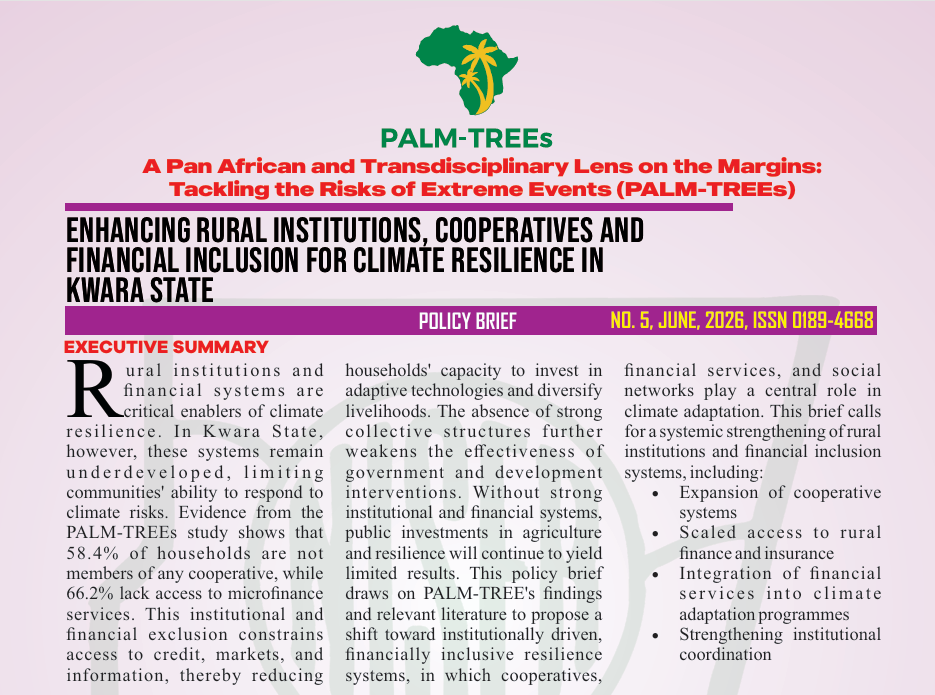
Rural institutions and financial systems are critical enablers of climate resilience. In Kwara State, however, these systems remain underdeveloped, limiting communities’ ability to respond to climate risks. Evidence from the PALM-TREEs study shows that 58.4% of households are not members of any cooperative, while 66.2% lack access to microfinance services. This institutional and financial exclusion constrains access to credit, markets, and information, thereby reducing Methodology households’ capacity to invest in adaptive technologies and diversify livelihoods. The absence of strong collective structures further weakens the effectiveness of government and development interventions. Without strong institutional and financial systems, public investments in agriculture and resilience will continue to yield limited results.
This policy brief draws on PALM-TREE’s findings and relevant literature to propose a shift toward institutionally driven, financially inclusive resilience systems, in which cooperatives, financial services, and social networks play a central role in climate adaptation.