
The Nigerian Institute of Social and Economic Research (NISER) has reaffirmed its commitment to providing evidence-based policy guidance for national development through the May 2026 edition of the NISER Research Seminar Series (NRSS), which examined the theme, “Prospects for the Nigerian Economy: 2026-2028.”
Held virtually on May 25, 2026, the seminar brought together researchers, policymakers, development practitioners, and stakeholders to discuss Nigeria’s medium-term economic outlook for the period 2026–2028. The event featured a presentation by Dr. Segun Awode of NISER’s Economic and Business Policy Department, with expert reviews by Professor Sulaiman Yusuf, an agricultural economist and policy consultant, and Elder David Adeosun, former Federal Director of Macroeconomic Analysis at the Federal Ministry of Budget and National Planning. The session was moderated by Mr. Louis Chete, while the Director-General of NISER, Professor Antonia Taiye Simbine, delivered the opening remarks.
In her opening remarks, Professor Simbine noted that the seminar reflects NISER’s longstanding tradition of macroeconomic forecasting, policy simulation, and quantitative economic analysis. She highlighted the Institute’s investments in developing indigenous capacity for macroeconomic modelling and policy analysis, emphasizing the importance of home-grown solutions to Nigeria’s development challenges.
The Director-General recalled that NISER had earlier projected that major reforms introduced since 2023—including fuel subsidy removal, exchange rate unification, and fiscal reforms—would generate positive outcomes despite short-term challenges. According to her, recent economic developments, particularly the moderation of inflation and improvements in fiscal performance, suggest that many of those projections are beginning to materialize.
She expressed cautious optimism about Nigeria’s economic outlook, noting that continued reform implementation, stronger revenue performance, infrastructure investments, and expansion of non-oil activities are expected to support gradual macroeconomic stabilization and economic recovery.
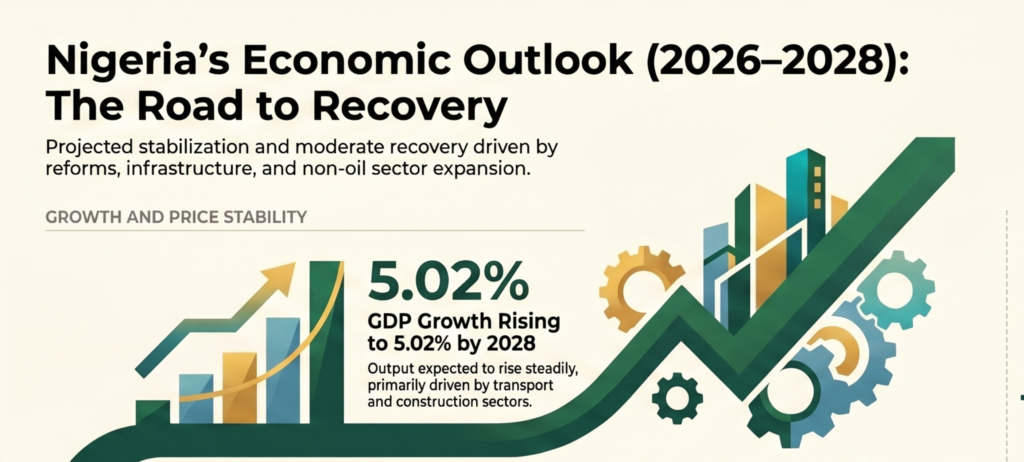
Presenting the report titled “Prospects for the Nigerian Economy, 2026–2028,” Dr. Awode explained that the projections were generated using the NISER Macroeconometric Model (Version ’24), a home-grown analytical framework designed to assess the interactions among key sectors of the Nigerian economy.
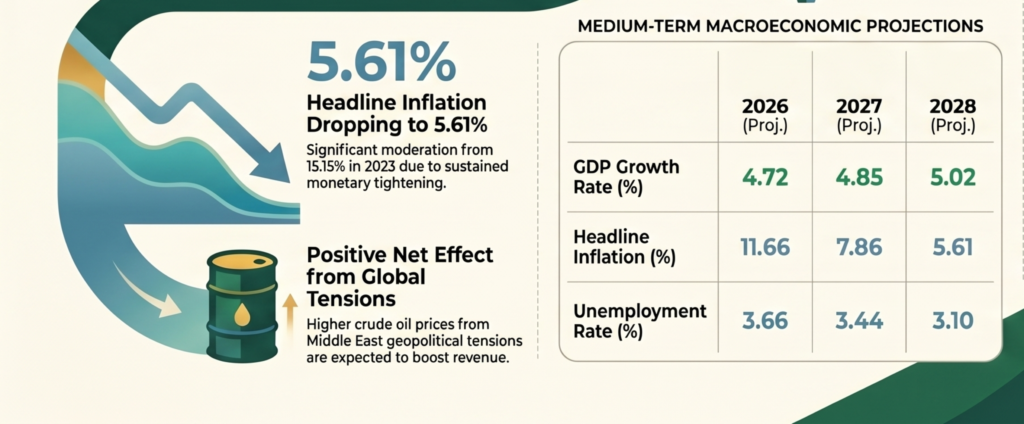
According to the projections, Nigeria’s Gross Domestic Product (GDP) growth rate is expected to rise from 4.72 percent in 2026 to 4.85 percent in 2027 and 5.02 percent in 2028. The projected growth is expected to be driven by sustained reforms, infrastructure investments, expansion in productive sectors, improved investor confidence, and relative stability in the foreign exchange market.
The presentation stressed that while the projected growth rates exceed the country’s population growth rate, Nigeria would need significantly higher levels of growth to achieve transformational development, create quality jobs, and substantially reduce poverty.
Inflation Expected to Decline Further
A major highlight of the outlook is the expected moderation of inflationary pressures over the forecast period. Headline inflation is projected to decline to 11.66 percent in 2026 and fall to single-digit levels thereafter. Food inflation is also expected to moderate considerably as agricultural production improves and supply conditions stabilize.
Dr. Awode attributed the anticipated disinflation to exchange rate stability, improvements in domestic agricultural production, sustained monetary policy measures, and positive supply-side developments, including increased domestic refining capacity.
Nevertheless, the seminar noted that global uncertainties, particularly geopolitical tensions in the Middle East and their effects on energy markets, remain important risks to the inflation outlook.
Fiscal Sustainability Improving but Challenges Remain
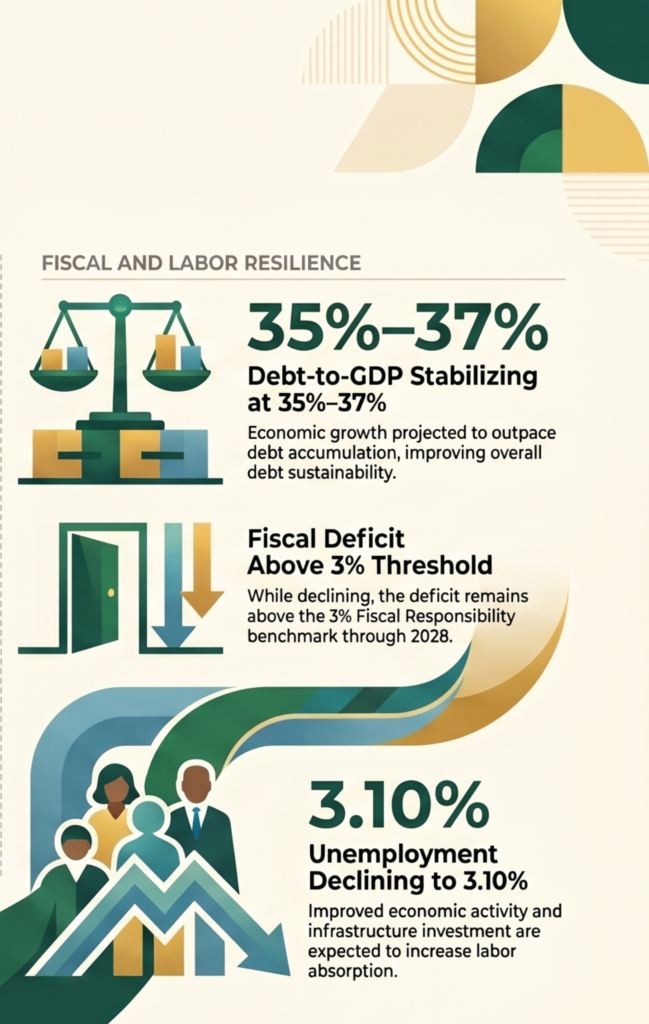
The outlook projects moderate improvements in fiscal sustainability indicators. The debt-to-GDP ratio is expected to stabilize at approximately 35–36 percent between 2026 and 2028, while the debt service-to-revenue ratio is projected to continue its downward trend following significant improvements recorded in recent years.
Despite these gains, concerns remain regarding fiscal deficits, which are projected to stay above the threshold prescribed under Nigeria’s Fiscal Responsibility framework. Participants emphasized the need to strengthen revenue mobilization, improve expenditure efficiency, and maintain fiscal discipline to ensure long-term debt sustainability.
The seminar also highlighted the importance of transparency in the utilization of subsidy savings, with participants calling for greater public accountability and clearer reporting on how reform gains are being invested in infrastructure, health, education, and social welfare.
Employment, Welfare, and Inclusive Growth
The report projects a gradual decline in unemployment over the forecast period, supported by expected growth in infrastructure, agriculture, and other productive sectors. However, discussants cautioned that improvements in headline unemployment figures may not fully capture the realities of underemployment and job quality.
Agriculture, Food Security, and Energy Transition
Food security emerged as a major area of discussion during the seminar. The presentation recommended increased investment in climate-smart agriculture, irrigation systems, greenhouse farming, improved storage infrastructure, and the adoption of digital and AI-driven agricultural technologies to boost productivity and reduce dependence on rain-fed farming.
The seminar also highlighted the need for investment in alternative and renewable energy sources. Rising energy costs, dependence on imported inputs, and broader energy challenges were identified as factors affecting productivity and competitiveness. Participants recommended greater investment in renewable energy technologies, biomass systems, and innovative energy solutions to support long-term sustainability.
The Discussant Session
Both discussants commended NISER for developing and sustaining a home-grown macroeconomic forecasting model capable of generating evidence-based projections tailored to Nigeria’s realities.
Professor Suleiman Yusuf described the initiative as a significant contribution to national policy analysis and praised the Institute for reducing dependence on external forecasting agencies. He noted that many of NISER’s previous projections had proven largely accurate and encouraged the Institute to continue strengthening its analytical frameworks.
Similarly, Elder Adeosun described the report as timely, practical, and policy-relevant, noting that its greatest strength lies in connecting economic projections with actionable policy recommendations.
At the same time, both discussants recommended strengthening future editions of the report through deeper scenario analysis, stronger welfare assessments, expanded qualitative research, enhanced attention to industrialization and the digital economy, and clearer explanations of the transmission mechanisms behind key projections.

Discussants further advocated stronger agricultural value chains, improved logistics systems, and enhanced support for smallholder farmers as critical measures for reducing food inflation and strengthening national food security.
Contributions from participants emphasized the need for stronger coordination among economic institutions, including NISER, the Central Bank of Nigeria, and relevant government ministries. There were also calls for improved real-time economic reporting, greater transparency in fiscal data, enhanced communication of reform objectives, and stronger mechanisms for monitoring economic performance.
Participants further highlighted the importance of leveraging private capital for infrastructure development, strengthening local government capacity, and ensuring that the benefits of economic growth are broadly shared across society
Participants repeatedly stressed that macroeconomic stabilization should not be viewed as an end in itself. Rather, economic reforms must ultimately translate into better living standards, quality employment opportunities, reduced poverty, and improved welfare outcomes for ordinary Nigerians.
Elder Adeosun emphasized that the success of economic reforms should be measured not only by improvements in macroeconomic indicators but also by their ability to improve household welfare and create inclusive development opportunities.
Responding to comments and recommendations, Dr. Awode welcomed the observations made by discussants and participants, noting that many of the issues raised would be incorporated into future editions of the outlook. He acknowledged the need for stronger scenario analysis, improved communication of policy transmission mechanisms, and deeper integration of welfare considerations into macroeconomic assessments.
Closing
In her closing remarks, Professor Oluwakemi Okuwa, Head of the Human Capital Department, emphasized the importance of continued collaboration between researchers, policymakers, and development stakeholders in shaping Nigeria’s economic future. She noted that the seminar demonstrated the value of indigenous analytical capacity and reaffirmed NISER’s commitment to rigorous research and evidence-based policy engagement.
The seminar concluded with a broad consensus that while Nigeria’s medium-term outlook presents encouraging signs of stabilization and recovery, sustaining growth will require policy consistency, fiscal discipline, enhanced productivity, stronger institutions, improved security, and deliberate efforts to ensure that economic progress translates into tangible improvements in the lives of citizens.