
NISER Policy Brief: Strengthening Fiscal Sustainability and Macroeconomic Stability: Policy Implications of Nigeria's 2026 Federal Budget for the Economic Sector
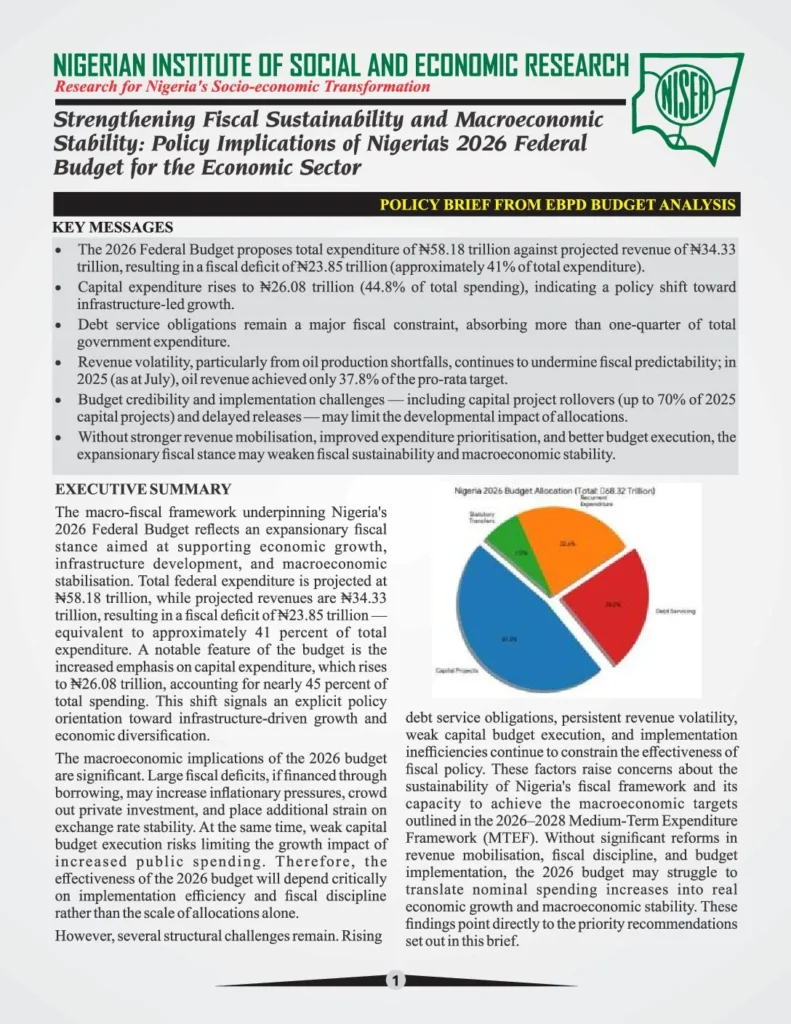
The macro-fiscal framework underpinning Nigeria’s 2026 Federal Budget reflects an expansionary fiscal stance aimed at supporting economic growth, infrastructure development, and macroeconomic stabilisation. Total federal expenditure is projected at ₦58.18 trillion, while projected revenues are ₦34.33 trillion, resulting in a fiscal deficit of ₦23.85 trillion — equivalent to approximately 41 percent of total expenditure. A notable feature of the budget is the
increased emphasis on capital expenditure, which rises to ₦26.08 trillion, accounting for nearly 45 percent of total spending. This shift signals an explicit policy orientation toward infrastructure-driven growth and economic diversification.
The macroeconomic implications of the 2026 budget are significant. Large fiscal deficits, if financed through borrowing, may increase inflationary pressures, crowd out private investment, and place additional strain on exchange rate stability. At the same time, weak capital budget execution risks limiting the growth impact of
increased public spending. Therefore, the effectiveness of the 2026 budget will depend critically on implementation efficiency and fiscal discipline rather than the scale of allocations alone. However, several structural challenges remain. Rising debt service obligations, persistent revenue volatility, weak capital budget execution, and implementation inefficiencies continue to constrain the effectiveness of fiscal policy.
These factors raise concerns about the sustainability of Nigeria’s fiscal framework and its capacity to achieve the macroeconomic targets outlined in the 2026–2028 Medium-Term Expenditure Framework (MTEF). Without significant reforms in revenue mobilisation, fiscal discipline, and budget implementation, the 2026 budget may struggle to translate nominal spending increases into real economic growth and macroeconomic stability. These findings point directly to the priority recommendations set out in this brief.